How the application sets the Authority up
The plan-based approach
This page shows the plan-based approach, and it answers one question from the RFP: how is the Authority set up consistently and correctly, with the proper planning already in place.
The words on this page are the words of its narration. Open the Listen bar at the foot of the page to hear them.
The application and its tabs
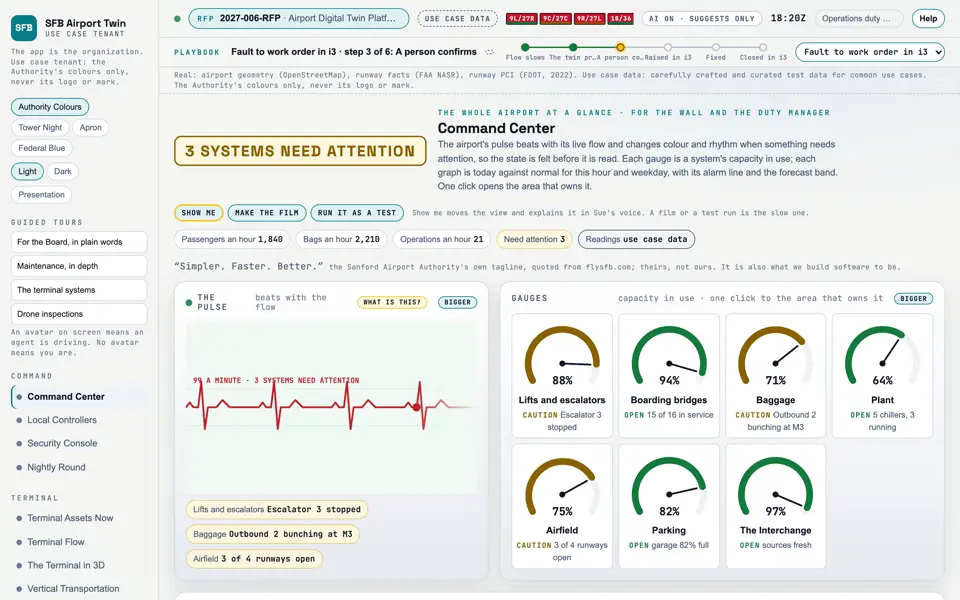
This page shows the plan-based approach, and it answers one question from the RFP: how is the Authority set up consistently and correctly, with the proper planning already in place.
The picture is the proof of concept as a whole, and the tabs run down its left side.
They run from Command at the top to Set up at the bottom.
Each tab is a group of screens, and each screen links to the requirement rows that name it.
Set up
The Set up tab is the planning part of the application.
It holds 12 screens, from the Rules and Data Library to References.
Implementation and Roadmap
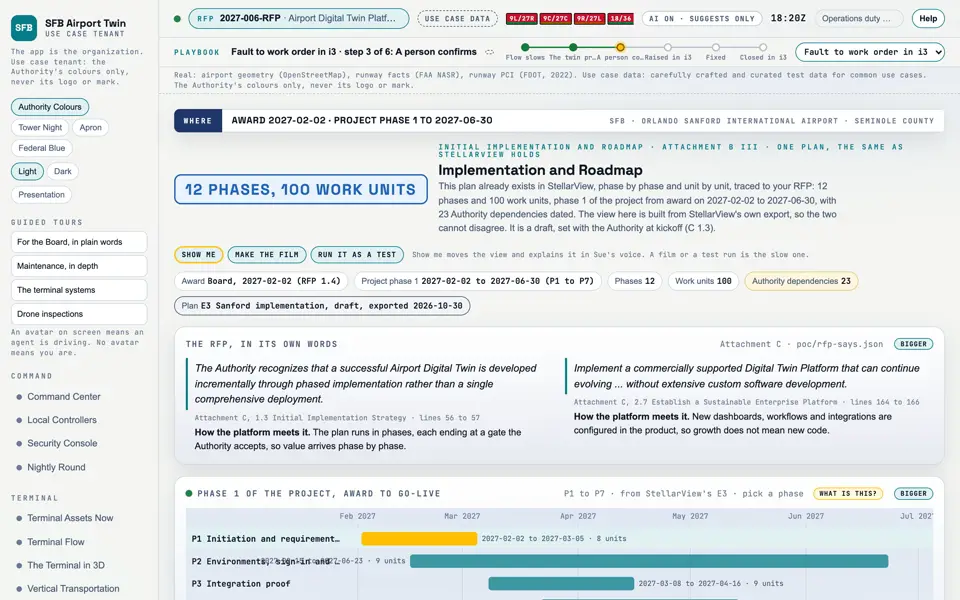
Implementation and Roadmap is the plan itself.
It shows the phases from kickoff to go-live, the Implementation Plan to approve, the Authority's participation, and acceptance and transition.
The plan has 12 phases and 100 work units, each traced to its RFP section and dated.
Each phase ends at a gate the Authority accepts, and the dates move with the award date.
The matrix has 34 rows that name this screen.
22 of them are target, and 9 are partly met.
The plan is phased and scheduled.
Phase one covers 7 of the 12 phases and runs from 2 February 2027 to 30 June 2027.
The Board minutes ask for completion by summer 2027, and the matrix marks that unconfirmed.
5 later phases carry the plan on, year by year, to 31 January 2032.
The phased, scheduled rollout is structured to carry plans at 1, 3, 5 and 10 years.
The plan data in the app covers phase one and the years that follow it.
The Authority's own master plan has a near term of 0 to 5 years, a mid term of 5 to 10, and a long term of 10 to 20.
Rules and Data Library
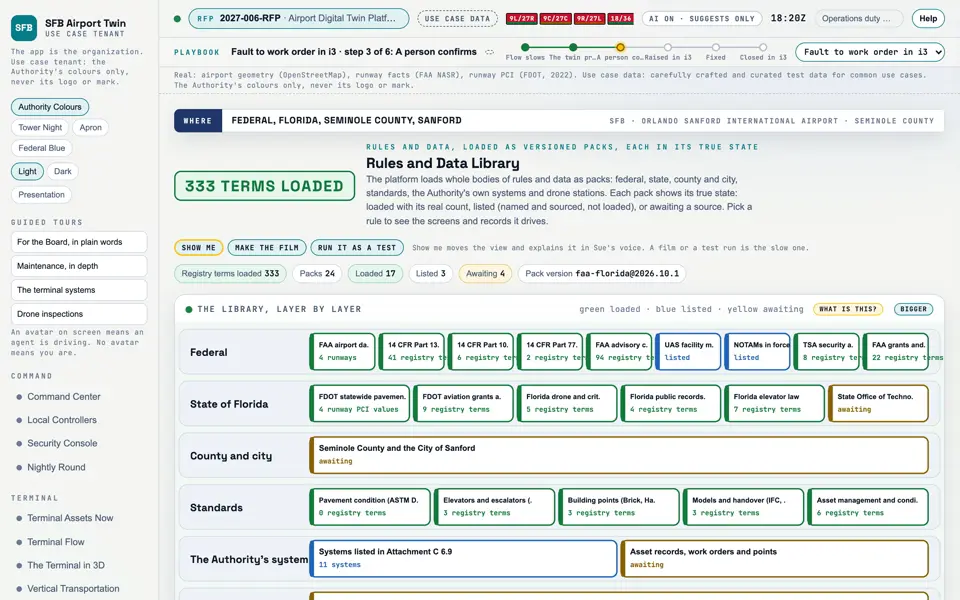
The Rules and Data Library comes before any custom work.
It lists every body of rules and data the platform has loaded and what each one drives.
It shows 24 packs, each in its true state: 17 loaded, 3 listed and 4 awaiting.
Graphical configuration of dashboards and workflows by the Authority's staff is the target, and the matrix marks it target.
Security and Administration
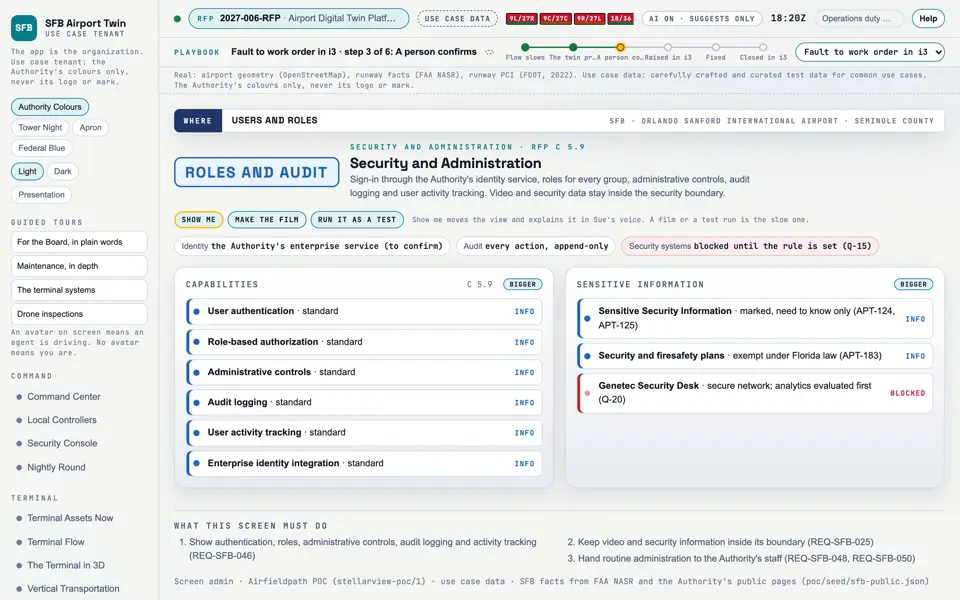
Security and Administration shows who can see what, with authentication, roles, administrative controls, audit logging and activity tracking.
The Authority's identity service is marked to confirm, and security systems wait for a rule.
Support
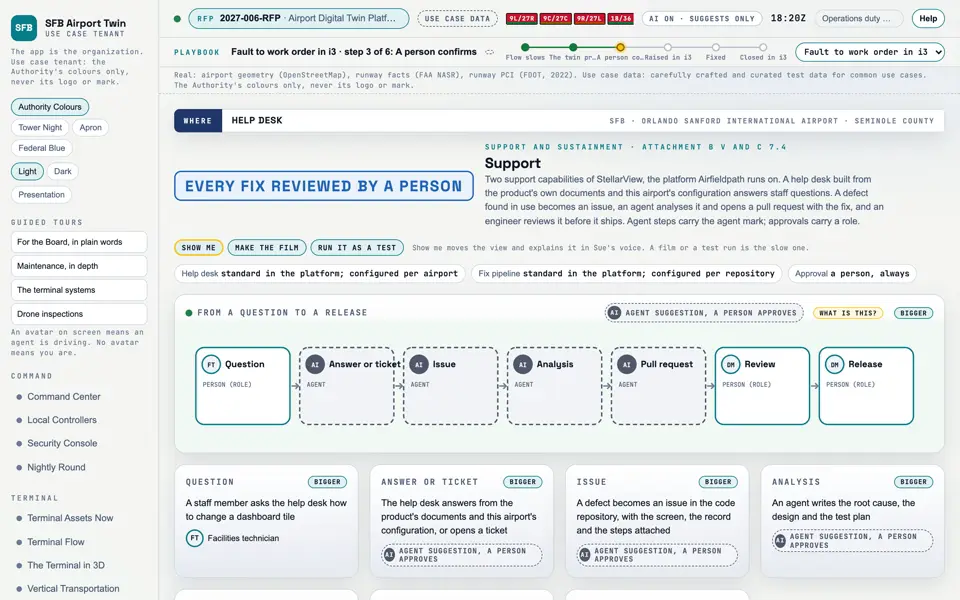
Support shows how staff get help, and how a problem found in use becomes a reviewed fix.
An agent analyses it and drafts the change with its tests, and nothing merges without an engineer's review.
Training courses for each user group and a hand-over are the target, and the matrix marks them target.
Environments and Operations
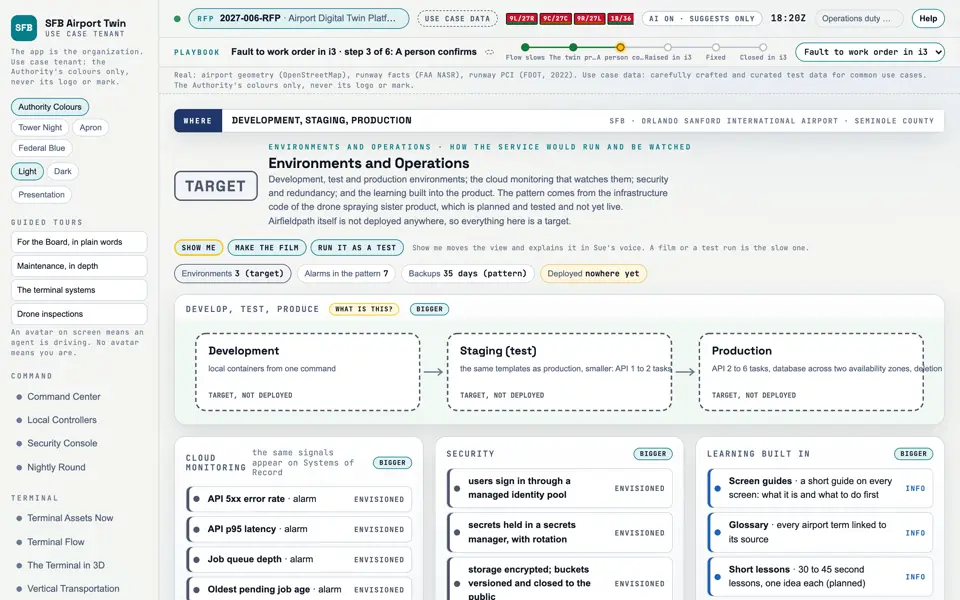
Environments and Operations shows development, test and production as a target.
It is labelled target because nothing runs in a cloud yet.
Intake and Systems of Record
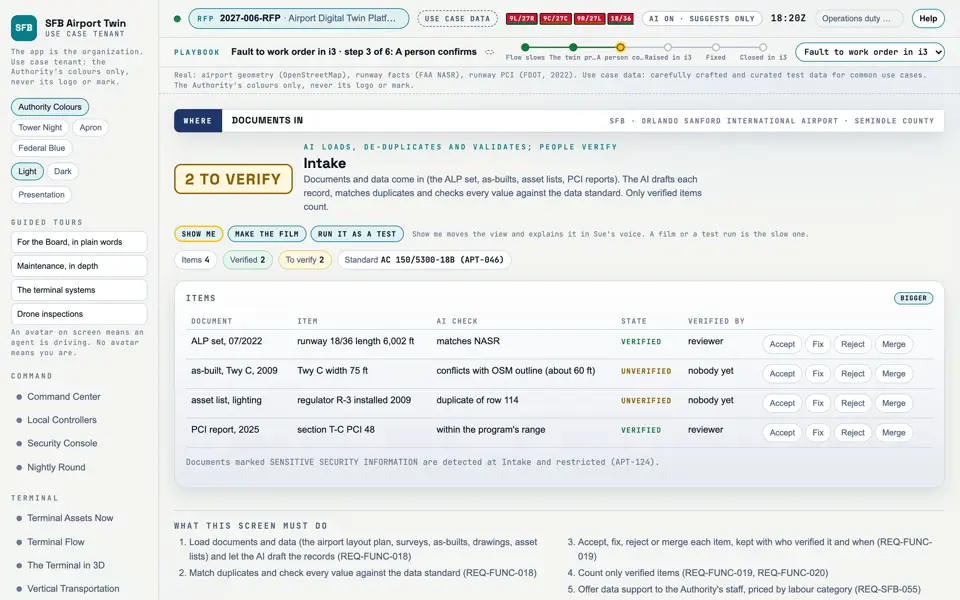
Further tabs in this group keep the setup honest.
Intake loads documents and data, lets the AI draft the records, and a person verifies each item before it counts.
Systems of Record proves that every value on every screen names the system that owns it.
The matrix gives 15 rows to Systems of Record, and says which are partly met and which are target.
That is the plan-based approach.
The RFP asks for a phased, configured and supported setup, the platform lays it out in the application, and the matrix states how far it goes today.
The requirements matrix states what is met, partly met or target for every row named here.